






 DARK
 4
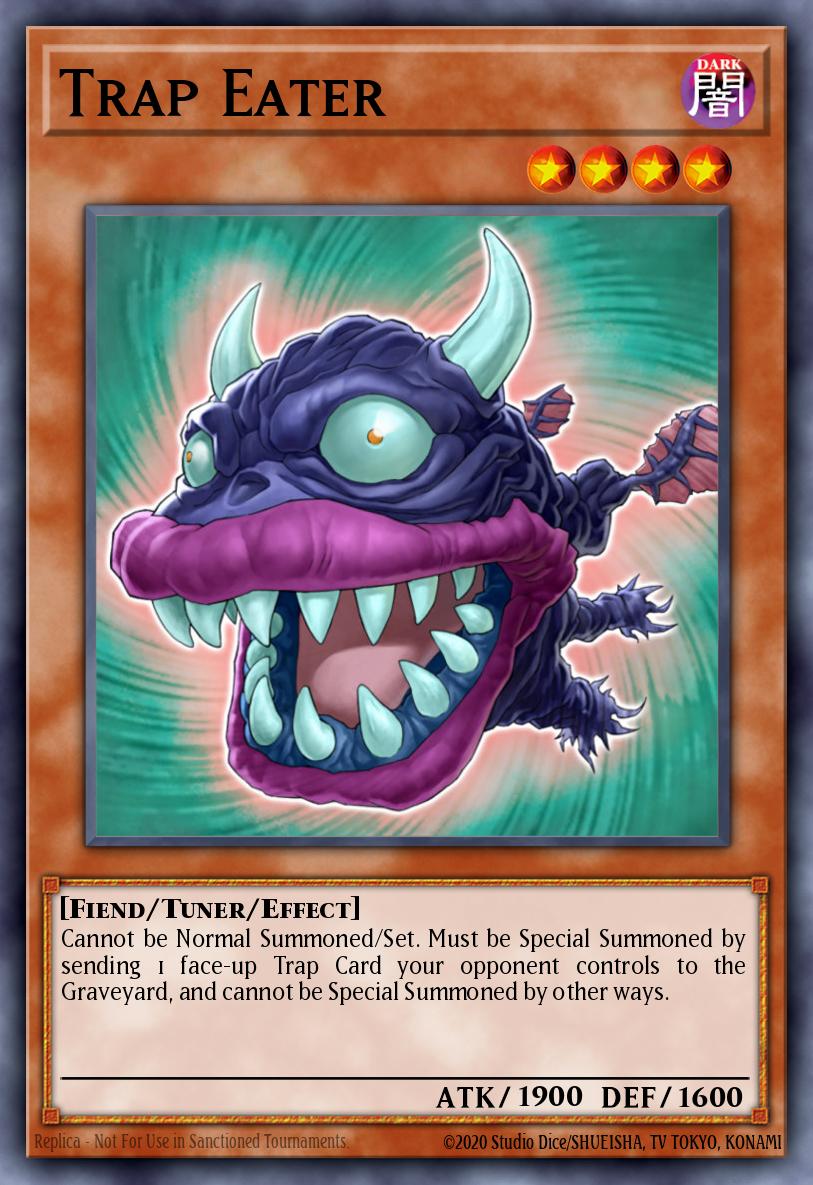
Trap Eater
ATK:
1900
DEF:
1600
View:
3429
Cannot be Normal Summoned/Set. Must be Special Summoned by sending 1 face-up Trap Card your opponent controls to the Graveyard, and cannot be Special Summoned by other ways.
Trap Eater — Power Evaluation
Final Score: 51 ± 6 · Confidence: Medium
- Intrinsic: 52.6 · Deck: 50.1 · Meta: provisional
- Primary role: Material body
Why it scores here
Trap Eater's power is mainly as a clean Level 4 DARK Tuner body for Synchro lines, which keeps its material value even if the summon clause is negated. Its summon condition is the main limit: it cannot be Normal Summoned or Set and needs an opponent's face-up Trap to send to the Graveyard, which makes it unreliable as a starter. The 1900 ATK and the 400-deck sample did not earn points by themselves; the score reflects the Tuner body and the conditional access.
Axis scores
| Axis | Score | Evidence |
|---|---|---|
| Accessibility | 30 | Cannot be Normal Summoned/Set and needs an opponent's face-up Trap sent to the GY, so it is not reliably live (verified card text; no searcher data). |
| Combo & Conversion | 40 | No recorded boards, so conversion is limited to a single Tuner body enabling Synchro, with no measured payoff (inferred). |
| Resource Economy | 45 | No card advantage or GY refuel; the opponent's trap is spent as a summon cost, a tempo trade rather than card gain (verified text, inferred value). |
| Effect & Interaction | 25 | The summon clause is its only effect and gives no negation or removal beyond the trap it sends away (verified text). |
| Material Utility | 72 | Level 4 DARK Fiend Tuner: a clean generic Synchro material that remains a Tuner even when its effect is negated (verified card type and stats; observed in Synchro decks). |
| Resilience & Flexibility | 40 | Once on the field it is a single vulnerable body with no recursion or second zone; resilience comes only from the spread of homes (observed, 75 archetypes). |
| Deck-Building Efficiency | 35 | Cannot be Normal Summoned, so a hand without an opponent trap is a brick risk; 1.71 average copies across the sample (verified text, observed copies). |
Calculation
Weight profile: Material body row only; no secondary blend (secondary_roles empty). Intrinsic ≈ 52.6, Deck ≈ 50.1, Meta = provisional. Modifiers: Self-locking restriction (-3). Final formula: 0.40*Intrinsic + 0.60*Deck
Strengths
- Clean Level 4 DARK Tuner body with generic Synchro material value (verified card type and stats)
- Run in all 400 sampled decks across 75 archetypes (observed)
- Co-occurs with Droll & Lock Bird and Ash Blossom in about 70% of sampled decks (observed; co-occurrence is not causal)
Weaknesses
- Cannot be Normal Summoned or Set (verified card text)
- Requires an opponent's face-up Trap to be sent to the GY (verified card text)
- No recorded board data to show what it converts into (data gap)
Counters / choke points
- Opponent runs no face-up Traps, leaving it without a summon route (inferred)
- Negating the Special Summon effect leaves only a Tuner body on the field (inferred)
Best use
Tuner / Synchro material body. Decks: Stardust / Synchron, Infernoble Knight, Archfiend. Suggested copies: 2.
Evidence & gaps
- Verified: Tuner Monster, Level 4, DARK Fiend, 1900/1600 (card data); Cannot be Normal Summoned/Set; requires sending 1 face-up opponent Trap to the GY (card text); Legal in TCG, OCG, MasterDuel, DuelLinks (card data)
- Observed: Present in 400 of 400 sampled decks across 75 archetypes (deck data); Copies per deck: 1 in 215, 2 in 85, 3 in 100 (deck data); Stardust / Synchron is the largest home at 22.5% of the sample (deck data); Droll & Lock Bird co-occurs in 71% of decks (deck data)
- Inferred: Primary role is Material body: a Tuner body with no recorded combo role; Accessibility is conditional on the opponent's face-up Trap; Brick risk when no opponent Trap is face-up
- Data gaps: No combos supplied; combo conversion is text-only inference No banlist token; assumed 3 copies (unlimited) No usage statistics (StatisticsCard); inclusion is from the deck sample only The deck sample contains the card by construction, so inclusion rates cannot be compared against the wider field